ON GROUNDS

What UVA Makes of You

MLI Student cohort standing on Rotunda steps

By Valentina Mendoza Gonzalez, [email protected] • June 30, 2026 

Every generation of students at UVA inherits the same unusual arrangement: student self-governance. The vast majority of programming, advocacy, and governance on Grounds has always been in student hands. At its core, the philosophy of student self-governance depends on students learning how to lead: how to make decisions, take responsibility, and act on behalf of a broader community.

In Student Affairs, leadership development is one of the primary ways this philosophy comes to life. Through programs that invest deeply in students as leaders, the division aims to strengthen the broader student experience by creating a ripple effect that extends beyond individual participants. The Meriwether Lewis Institute for Citizen Leadership (MLI) represents one such effort: a multi-year fellowship for rising second-years that immerses students in leadership through a four-week summer institute, coursework in the Frank Batten School of Leadership and Public Policy, and a shared expectation that they will leave UVA better than they found it.

This piece brings together reflections from two Student Affairs staff members and two students involved in MLI to explore what leadership looks like within a self-governed community—and what happens when students are trusted to carry it forward. 

A Legacy of Trust

Julie Caruccio remembers this environment from her own days as an undergraduate. She is a double ‘Hoo who grew up in Charlottesville, where her father taught history for nearly three decades. Before she became the Assistant Vice President for Strategic Initiatives, she was a student doing what UVA students tend to do: find something you care about and run with it. That meant DJing at WTJU, running UVA's jazz concert series as assistant director, serving as a resident advisor, and riding on the equestrian team. Today, she still follows that instinct and rides down the football field as the University's Mounted Cavalier. Her time on Grounds taught her that responsibility belongs to the community rather than any one group. She saw student self-governance as a constant practice. "This University says: we trust students to act on our behalf on things that matter," Caruccio says. “It's one of the things that makes UVA unique.”
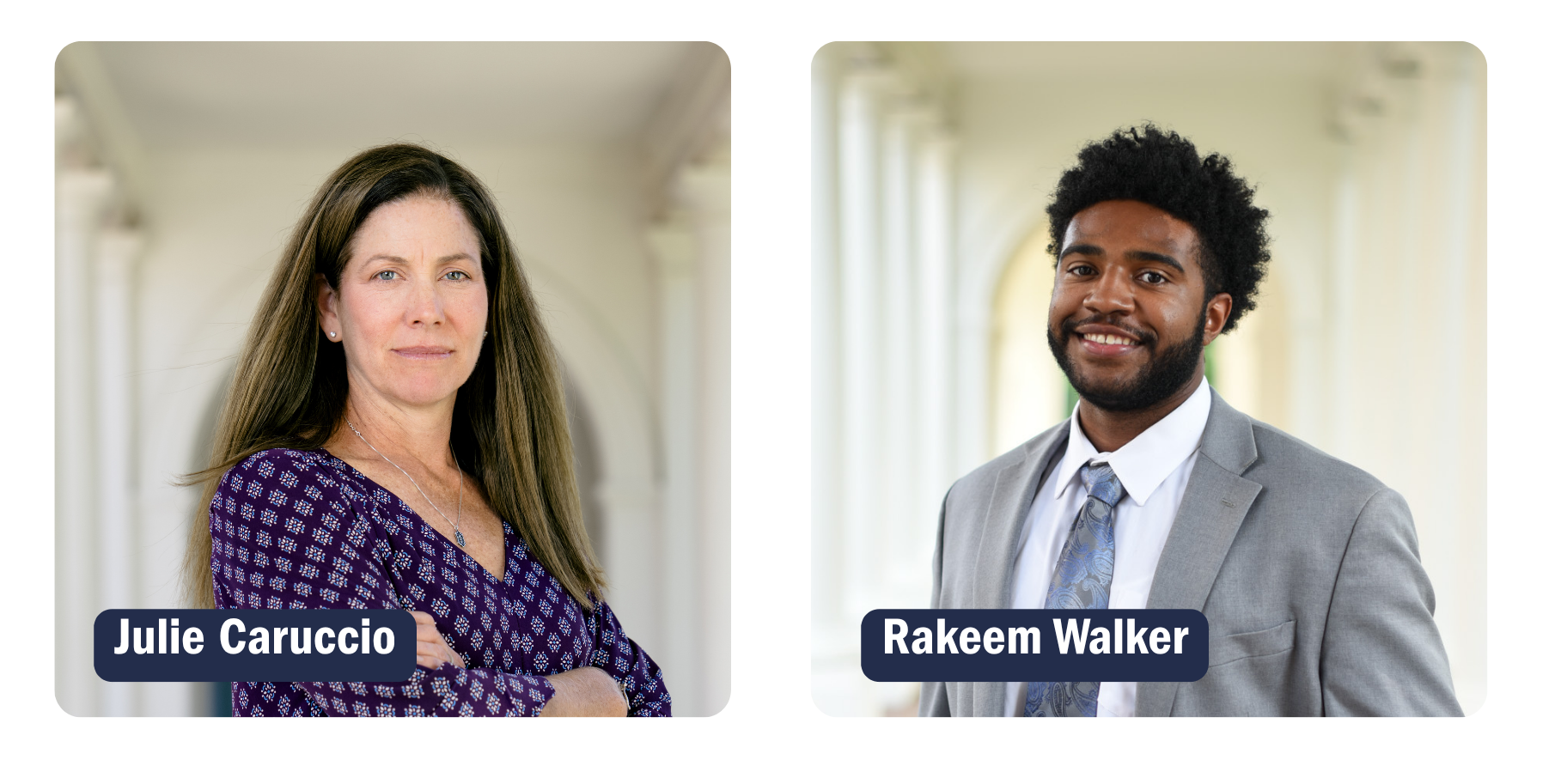
This University says: we trust students to act on our behalf on things that matter. It's one of the things that makes UVA unique.
Julie Caruccio, Assistant Vice President for Strategic Initiatives

That trust accumulates. It shapes how students see themselves and what they believe they are capable of. It is also, Caruccio has learned, what makes alumni perk up when they talk about their time here, and employers wonder what could possibly be in the water at UVA.

Picture of Julie Caruccio and Rakeem Walker

Breaking the Bubbles

Rakeem Walker is the program coordinator for the Office of the Vice President of Student Affairs. He came to UVA after graduating from Hampden-Sydney College, where he served as president of the Minority Student Union and a resident advisor. He also built a peer mentorship initiative called Brother for Brother. Off the clock, he continues to invest in mentorship and coaches AAU youth basketball. His instinct, in every context, is to find the person who needs someone in their corner and be that person.

At UVA, that inclination shapes how he leads MLI. The program is deliberately designed to put students in rooms with people they would never otherwise meet, breaking down the silos that form inside specific majors and student organizations. "If I didn't do MLI, me and this other student would never have crossed paths," Walker says, echoing a sentiment he hears every summer. The connections that form in MLI are not incidental. They are the point. "When you develop as a leader alongside your peers," Walker says, "you develop as a person."

He watches students arrive unsure of themselves and leave with something they did not know before. "They come in shy, unsure, and then you see the change." What changes is not ambition – most MLI Fellows arrive with plenty of that. What changes is where they think their power truly comes from. 

Believing in Power

Connor Chang is a rising third-year Echols Scholar studying physics. When he arrived on Grounds, he associated leadership with titles. That changed when he started watching how UVA actually worked. Student organizations manage their own structural challenges. They navigate internal disagreements without oversight from above. They control real budgets and make decisions that affect real people. "The best way to operate," Chang says, "is to believe you have power." He also realized that holding this responsibility is rarely easy. "CIOs are not always happy go lucky," he said. "I believe that is a reflection of how much students care."

Gelila Solomon arrived with similar skepticism about the word. She is also a rising third-year, studying data science. During her first year, she found herself taking on responsibility simply because she cared about the people around her. She did not come in with a set title, but with an aptitude to follow through and be present. Over time, her understanding of influence changed. "Leaders come in many forms," Solomon says. "You don't need to be the loudest in the room." What she came to value was a genuine level of mutual understanding between students who simply want better for each other. The willingness to understand the context of our community before you use your power to change it. 

Both Chang and Solomon joined MLI's newest cohort this spring. Neither applied because they had it figured out, but because UVA had already started changing how they thought about who gets to lead and what that actually looks like. This summer, their cohort was given a prompt: how do you increase connectivity on Grounds? Chang and Solomon worked together alongside their peers on a proposal for The Terrace, a reimagined outdoor gathering space designed to draw students out of their usual orbits and into community at the heart of North Grounds. They pitched it to a room of UVA stakeholders with the central case that one must create the conditions for people to find each other before they know they need to. 

Picture of Gelila Solomon and Connor Chang

What UVA Makes of You  

Talk to Julie, Rakeem, Connor, and Gelila long enough, and a pattern emerges. None of them arrived with a clear picture of themselves as leaders, but all of them arrived with curiosity and the willingness to act on it.  

Student self-governance produces conditions for discovery, for friction, for the kind of growth that does not reveal itself until you are already on the other side of it. When a student steps into their own version of leadership here, they are able to change what each subsequent generation of students sees as possible.  

Our University provides the space. What students make of it is entirely up to them. And that, it turns out, is exactly the point.