LEADERS ON THE RISE

Fifty Years of Finding Your Place

oaaa student peer advisors sitting on sofa's

By Valentina Mendoza Gonzalez, [email protected] • February 26, 2026 

A House Built by Students

The Office of African-American Affairs (OAAA) started the way many initiatives at UVA do. Students asked the University to live up to its promise, and then they got to work. In 1975, the Black Student Alliance proposed an office that would be operational by the summer of 1976. Within a year, controversy over a segregated local club required students to revise and refine their focus. Out of that era came an office with a simple charge: help all students thrive, and make sure they know this university is theirs. Half a century later, the charge still holds.

The OAAA Peer Advisor Program was established in 1984. It assists any and all first-year and entering transfer students with their college transition by providing personalized support and counseling through a wide range of activities from orientation to workshops and seminars to academic recognitions. Peer advisors meet new students early, translate how the place works, point to tutoring and leadership opportunities, and make help-seeking feel normal. These students do the steady confidence-building work that turns what could be a cumbersome first semester into a sense of connection. And because each Peer Advisor carries out this mission in their own way, they each get the chance to share a piece of wisdom they’ve earned with others. 
Meet the Peer Advisors

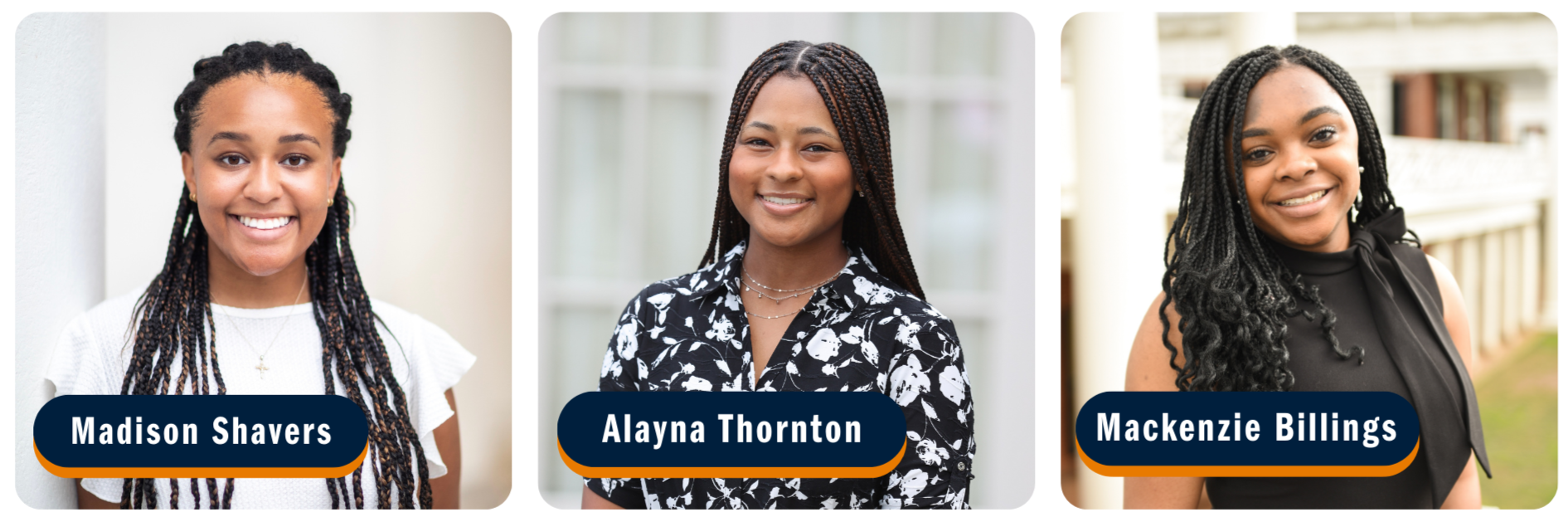
Madison Shavers, Alayna Thornton, Mackenzie Billings

“I didn’t have UVA at the top of my list,” Mackenzie says. “I just really wanted to know if I could be authentically myself and if I’d be supported.”

She found her footing through people first – mentors who didn’t shrink their ambitions and encouraged her not to diminish her own. Now a psychology major on the pre‑med track with a chemistry minor, she pours that same energy into the next cohort. “STEM representation is not where it could be,” she says. “That’s why I focus on confidence. Building confidence is a testament to what OAAA has given us.”

Her advising is practical and personal. “We have free STEM tutoring. We share study practices. We normalize asking for help.” Then she pauses, remembering a recent interaction. “I had an advisee last year—pre‑med, very driven, thinking of graduating early. I got an email to check in because her parent had passed. I can’t imagine what that feels like. That’s when it hit me that these relationships don’t end after the first year. They only deepen.”

Pressed to share just one thing she wishes every first‑year knew, she keeps it honest.  

Being unapologetically yourself and taking up space has been very formative for me, and every student deserves that.
Mackenzie Billings, 4th Year Student

“I learned mentorship by watching my two older sisters,” Alayna says. “I just watched them move through life. When I got to UVA and had the peer support system, it was everything. So I wanted to pay it forward.”

As a fourth‑year majoring in commerce and IT, she measures impact in two ways: what advisees do and how they feel. “On the selections committee, I watched first‑years tell their stories and then grow into them. Seeing them be more confident, more involved—that’s why you do it.”

She’s direct about the realities of keeping the legacy moving. “Visibility matters. These programs are pipelines, and pipelines need to be shared consistently or they shrink.”

Alayna thinks a lot about transitions and pressure and the myth that leaders never doubt themselves. “We come to the table equipped to guide someone else,” she says, “but we forget to guide ourselves. You uplift others — you also have to uplift yourself.”

By the time she finishes telling her story, the through‑line is obvious: care is a two‑way street. And the lesson she carries forward is simple, but not always easy.  

Be what you are to others for yourself. Be gentle with yourself.
Alayna Thornton, 4th Year Student

Madison arrived in first year expecting a standard mentorship setup. “I thought I’d get a couple course recommendations or a dining hall tip,” she laughs. “I didn’t understand how much this program meant to people.”

It didn’t take long. “You’re trained with resources to serve any student in any major or department. And when something’s beyond you, there’s a whole network, someone always knows something.”

She remembers the moment she realized she’d become someone’s person. “One of the first students in my caseload had a tough roommate situation, which was tiny on paper, but huge for an 18-year-old. We talked it through. At the end she told me I was ‘a wise, old friend.’ The ‘old’ hurt, I was freshly 20, but it meant I’d become a big sister, which I’ve never been. She’s still the little sister I never had.”

Madison is candid about the transition to UVA. “I was overwhelmed. I even considered transferring. Finding your niche changes that. Imposter syndrome is real. At the end of the day, you have to trust your gut. If you weren’t meant to handle the position you’re in, you wouldn’t be in it.”

And her bottom line about the program’s value is simple: 

“You will always walk away from the program a better person and with a community that has your back.”
Madison Shavers, 4th Year Student

The Dean who Came Back to Lead

Dean Darren Kelly knows OAAA from both sides of the welcome desk. He arrived as an undergrad from Southern California in 2000, met his Peer Advisor, and thought he’d be headed for corporate America. “I didn’t come out of college thinking I’d do this work,” he says. Then the advising did what advising does: it rerouted him. He became a Peer Advisor, then discovered that helping students connect passion to opportunity was more than a side interest. It became the work. “My experience as a Peer Advisor led to my assistantship at UT Austin. I started a peer mentoring program there, modeled on what we did here.”  He kept returning to a simple conviction: the most scalable force for belonging is students helping students.

His north star hasn’t changed. “Helping students connect passion to opportunity is rewarding. Hearing hopes and dreams—it’s a breath of fresh air. Then aligning that with resources so they can make this place a community where they can thrive and belong”—that’s the goal, he says. Kelly also carries forward a teaching from longtime program architect Sylvia Terry: just because you’re here doesn’t mean you feel like you belong—but the reality is, this is your university.

Across years and roles, the pattern he sees is continuity with growth. “When I have an opportunity to connect with alums, they are amazed at what we are still doing and all the programs and initiatives we now offer,” he says. “We have expanded the role of Peer Advisor to better serve students from a wide array of backgrounds and lived experiences. Students are taking ownership in this University and leaving their own legacy. I am privileged to carry the torch for all those who came before me.” 

Black Alumni Weekend, people hugging and swaying left and right.
Black Alumni Weekend has brought generations of alumni together in celebration of the Black community at UVA.

The next fifty years

The office’s mission is straightforward: help all students, regardless of their identity, thrive academically, socially, and personally, in partnership with the wider University. Peer Advisors advance that mission by insisting that the next person feels a little steadier, a little braver, a little more at home. Anniversaries give celebrants room to name what and who brought them to this point, and to decide how they will keep raising the village that comes next. The Office of African-American Affairs will mark its next decade the way it marked the last five: find your place, make it yours, and then show someone else the way.  


OAAA programs, support services, spaces, and events are open to all students, regardless of age, color, disability, gender, gender identity or expression, marital status, military status, national or ethnic origin, race, religion, sex, sexual orientation, or socioeconomic status. We are committed to fostering an environment where everyone is valued and respected.